
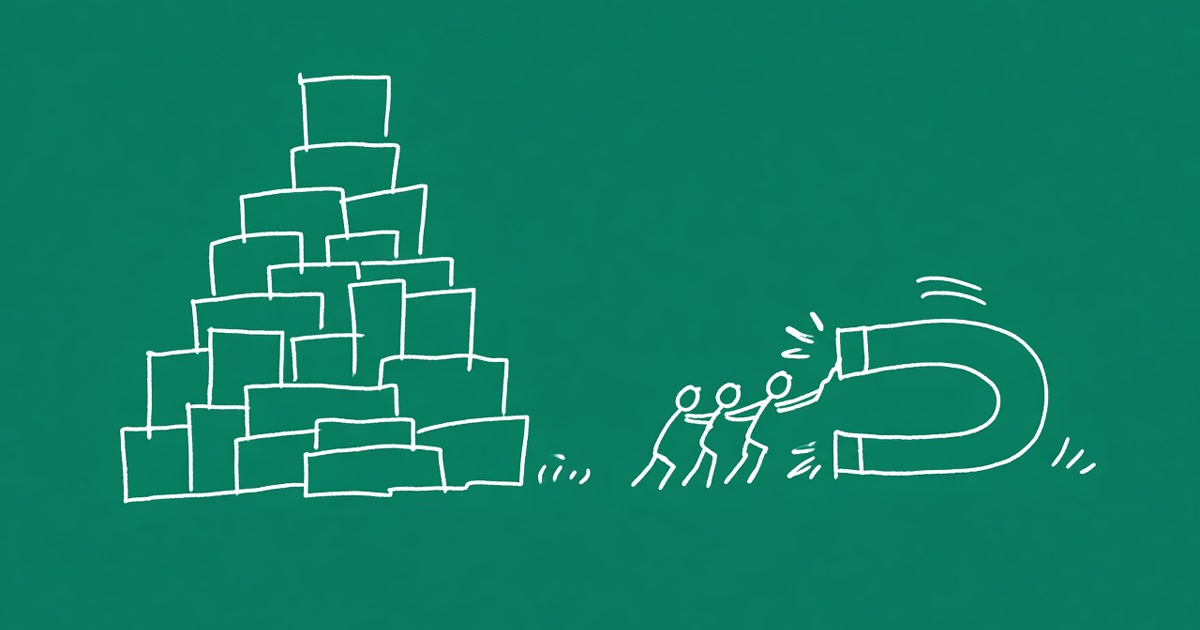
Most founders I talk to are using AI to build faster. That is rational. The cost of standing up a product, a prototype, even a full delivery motion has dropped hard in a short period of time.
What has not dropped is the cost of finding, winning, and keeping a customer.
If anything, that part got harder. There is more software, more agencies, more “AI-native” services firms, and more noise in every buyer’s inbox. Building is no longer the scarce resource. Attention and trust are.
At 367 Ventures, we have said for years that finding effective ways to acquire and retain customers at scale is the single biggest factor of success. That was true when Brad Schneider and I were building Rightpoint. It is more true now.
The sequence problem
When something gets cheaper, people do more of it. I wrote about that earlier this year in the context of the workforce — Jevons Paradox, and why efficiency tends to create more demand, not less. The same instinct shows up in how founders spend their weeks.
If AI helps you ship another feature, write another proposal, or stand up another internal tool in an afternoon, that is what Friday looks like. The calendar fills with building. Meanwhile the unglamorous work — talking to buyers, testing a message, learning which channel actually produces a repeatable customer — keeps getting pushed to next month.
That is a sequencing error, not a work-ethic problem. A company can only compound one bottleneck at a time. If you do not yet have a reliable way to get the next ten customers, making delivery 30 percent more efficient is not leverage. It is a cleaner way to stay quiet. The unfair advantage we look for rarely starts with a better internal tool. It starts with a team that can win a customer on purpose, then do it again.
A launch is not a motion
A launch is an event. A motion is a system. Plenty of early teams now have the first one: a site, a demo, a first cohort delivered. AI has made that bar easier to clear. It has also made it easier to confuse activity with a market.
A real customer-acquisition motion answers a short list of unromantic questions:
- Who is the buyer, by title and situation, not by persona slide?
- What problem is painful enough that they will change what they already do?
- What message makes that problem feel specific, not generic?
- Where do those buyers actually pay attention?
- What does it cost, in time and money, to win one — and to keep one?
- Can someone other than the founder run a version of this, or does every deal still require heroics?
If you cannot answer those questions with evidence, you do not have a go-to-market. You have a hopeful calendar. The fix is not another feature. It is more cycles with the market.
This is also why “we will add sales later” is usually backwards. Later is when the story has already hardened, the pipeline is founder-only, and the team is busy serving the handful of customers it happened to get. Installing a motion then is possible. It is just more expensive, and it usually requires unlearning.
Spend the first AI leverage on learning, not only on delivery
I am not arguing against efficiency. Brad and I built a services firm. I care about delivery quality, margin, and whether a team can scale without falling over. AI should take work out of staffing, scoping, production, and reporting.
I am arguing about order.
The highest-value early use of these tools is shrinking the time between a market hypothesis and a clear yes or no. Use them to prepare better conversations, to synthesize the last ten sales calls, to test messaging, and to follow up like a professional instead of a busy founder. That is leverage against the actual bottleneck.
Using the same tools only to produce more output — more pages, more features, more decks — can make you feel fast while you learn slowly. Speed without a feedback loop is just a more efficient way to stay wrong. A practical test for 2027 planning: for every internal build on the roadmap, name the customer-learning question it is supposed to answer. If you cannot name one, it is probably a comfort project.
What this looked like when we were the operators
Rightpoint started as a two-person firm in 2007. We did not begin with a polished platform or a large marketing engine. We began with customers, a point of view about digital experience, and a willingness to go get the work. The firm grew from there — eventually a global team, later a sale to Genpact in November 2019 — because we kept treating customer acquisition as a core operating problem, not as a department we would stand up once the work was “ready.”
The work is never ready. Buyers do not wait for your roadmap to feel complete. They have a problem now, and they will hire the team that can describe it clearly and solve it reliably. The sequence does not change: earn a repeatable way to get and keep customers, then spend efficiency gains to serve more of them better. Flip it, and you get a beautifully operated business that still depends on hope.
What we look for now
When we meet founders, we look for next-generation technology on purpose. We also look for a coachable team that is honest about where the bottleneck is.
The teams that impress us late in 2026 are not the ones with the longest list of things AI can do for them. They are the ones who can show their working: a defined buyer and a tested message; a channel they can explain, including what has already failed; early proof that customers stay, expand, or refer — even if the numbers are still small; and a plan for turning the founder’s personal selling into a system.
Coachability shows up here in a practical way. Brilliant people can fall in love with the build. Coachable people will change the sequence when the evidence says the market is not moving.
A simple 2027 sequence
If you are planning the year right now, I would put the work in this order.
First, make customer acquisition a weekly operating rhythm. Not a quarterly offsite, and not a hire you will “get to.” Time on the calendar with buyers. Notes from those conversations. A short review of what is converting and what is not. If this is not already a habit, it is the habit.
Second, turn what you are learning into a motion another person could run. Write down the message, the steps, the handoffs, and the definition of a qualified opportunity. If it only lives in the founder’s head, you do not have a system yet.
Third, spend AI and automation on the constraint you just proved. Once you can win customers on purpose, efficiency becomes real leverage: faster delivery, better experience, healthier margins, more capacity. That is the point at which “build faster” starts to compound.
None of this is glamorous, and it is not a new theory. It is the same playbook we have used to decide which founders we want to advise, mentor, and invest in — applied to a moment when building got suddenly cheaper.
The founders who come out of 2027 stronger will not be the ones who produced the most. They will be the ones who learned the fastest where their next customer comes from, and then used every new tool to do more of that on purpose.
Building got cheap. Customers did not. Sequence accordingly.

